


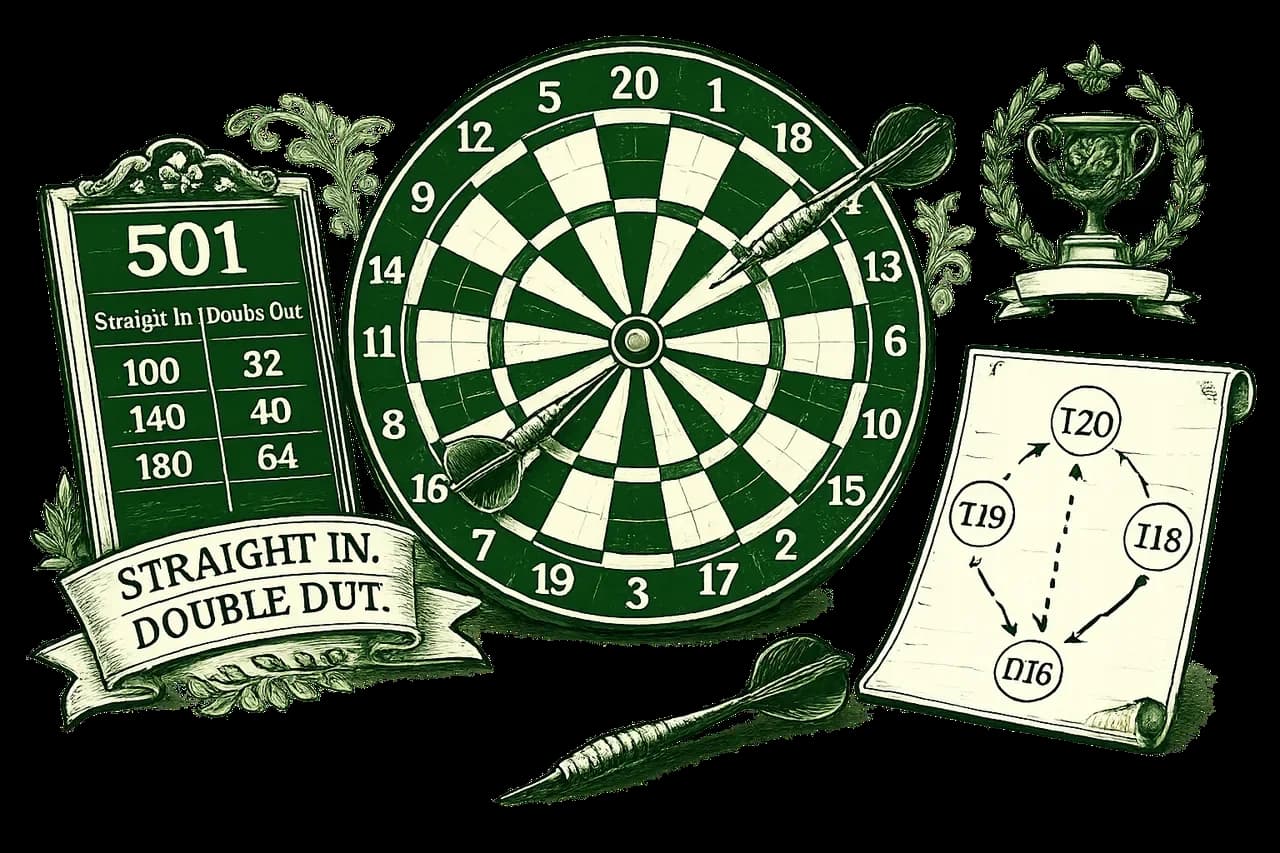
Darts 501 is the most popular form of the game, played both casually and in professional tournaments. Every player starts with 501 points and must reduce the score to exactly zero before the opponent does. In the Straight In, Double Out format, scoring begins with any valid hit, but the final dart must land in a double segment.
Although the rules are simple, playing 501 well requires more than aiming at the highest-scoring area. Consistency, planning the finish, mental arithmetic and choosing routes that leave comfortable doubles are all essential.
What Does Straight In Mean?
Straight In means that a player begins scoring with the very first dart. There is no need to hit a double before points start counting. Every valid score is immediately deducted from 501.
This is the simplest and most commonly used way to begin a leg. From the opening visit, the player can concentrate on scoring as heavily as possible. The usual target is treble 20, written as T20, which is worth 60 points.
The maximum score in one visit is 180, achieved by hitting T20 three times. That does not mean every dart must always be aimed at this segment. For a beginner, consistency matters more than an occasional huge score. Three single 20s produce 60 points, while three inaccurate attempts at T20 may result in a much lower total.
What Does Double Out Mean?
Double Out means that the final dart of the leg must hit a double. If a player has 40 points remaining, D20 finishes the leg. With 32 left, the target is D16, and with 24 left, D12 is the direct finish.
The centre of the board can also be used to finish. The outer bull is worth 25 points, while the inner bull is worth 50 and counts as a double.
In Double Out, the score must reach exactly zero. If a player scores too many points, leaves a score of one, or reaches zero without hitting a double, it is a bust. The score returns to the value at the start of that visit and any remaining darts are lost.
For example, a player beginning a visit on 32 can finish by hitting D16. If the dart lands in single 16, 16 remains and D8 becomes the next target. If the player instead scores 17, 15 remains. That score can still be finished, but it requires another setup shot.
The Most Important Strategy: Think One Dart Ahead
In 501, do not think only about the dart currently in your hand. Before throwing, know what score will remain after hitting the intended target and what options the next darts will provide.
This becomes especially important below roughly 230 points. From that range, players can begin setting up a score that may be finished in three darts. The highest possible checkout is 170:
T20, T20, Bull.
However, not every score below 170 can be finished with three darts. The so-called bogey numbers include 169, 168, 166, 165, 163, 162 and 159. There is no three-dart checkout for these scores, so it is usually wise to avoid leaving them.
For example, from 229, hitting T20 leaves 169, which cannot be finished in three darts. A better choice may be T19. Scoring 57 leaves 172 and gives the player a better chance to set up a finish with the next visit.
The Best Double Segments
D20, which finishes 40, is often considered one of the most practical doubles. It is located at the top of the board, and a dart that misses inside into single 20 leaves 20 for D10.
D16 is also extremely popular. A score of 32 can be divided in a convenient sequence:
D16 → D8 → D4 → D2 → D1.
If the player hits the single number instead of the double, an even score remains and another double is available. This makes 32 one of the best scores to leave.
Other comfortable finishes include:
- 40 — D20
- 36 — D18
- 32 — D16
- 24 — D12
- 20 — D10
- 16 — D8
Learn which double suits you best. If D16 is your strongest double, try to leave 32. You do not always need to follow the route most commonly chosen by professionals. The best route is the one that matches your own accuracy.
Important High Checkouts
High finishes should be learned gradually. Some of the most useful are:
- 170 — T20, T20, Bull
- 167 — T20, T19, Bull
- 164 — T20, T18, Bull
- 161 — T20, T17, Bull
- 160 — T20, T20, D20
- 158 — T20, T20, D19
- 157 — T20, T19, D20
- 156 — T20, T20, D18
- 154 — T20, T18, D20
- 152 — T20, T20, D16
- 150 — T20, T18, D18
- 148 — T20, T16, D20
- 146 — T20, T18, D16
- 144 — T20, T20, D12
- 141 — T20, T19, D12
- 140 — T20, T20, D10
There is no need to memorize the whole checkout chart in one day. Start with scores below 100, because these appear most often in amateur games.
Useful Combinations Below 100
Many two-digit scores can be finished in two darts:
- 100 — T20, D20
- 96 — T20, D18
- 92 — T20, D16
- 88 — T20, D14 or T16, D20
- 84 — T20, D12
- 80 — T20, D10 or T16, D16
- 76 — T20, D8
- 72 — T16, D12
- 68 — T20, D4
- 64 — T16, D8
- 60 — 20, D20
- 56 — 16, D20
- 52 — 20, D16
- 48 — 16, D16
- 44 — 12, D16
- 42 — 10, D16
For some scores, it is better to aim at a large single rather than a treble. With 60 remaining, 20 followed by D20 is safer than aiming at T20. Hitting the treble would reduce the score to zero without a finishing double and therefore cause a bust.
How to React After a Miss
A good checkout route should allow for possible misses. Professional players often choose targets that still leave a realistic finish if the dart lands in the single segment.
With 80 remaining, T20 followed by D10 is a popular route. If the first dart lands in single 20, 60 remains and can still be finished with 20, D20. With 82, the bull is a useful first target. Hitting 50 leaves D16, while hitting the outer bull for 25 leaves 57, which can be finished with 17, D20.
Do not throw the next dart automatically. Recalculate the remaining score after every dart and select a new route. A few seconds of thought can prevent leaving one point or creating an unnecessary bust.
Scoring at the Start of a Leg
At the beginning of the game, the priority is steady scoring. T20 is the standard target, but if your darts frequently drift into 1 and 5, consider switching to T19. Misses into the neighbouring 7 and 3 may be less damaging than repeatedly scoring ones and fives.
Do not change target after every poor dart. Work on a repeatable stance, grip and rhythm. A strong average comes mainly from avoiding very weak visits, not from scoring an occasional 180.
It is also useful to separate scoring practice from checkout practice. You can throw sets of darts only at T20, T19 and T18, and then practise finishing scores from 40 to 100.
How to Practise Double Out
A useful exercise is “Around the Clock Doubles”. Try to hit D1, D2, D3 and every following double up to D20, then finish with the bull.
Another effective drill starts from 40. Try to finish the score with three darts. After a successful checkout, increase the starting score to 44, 48, 52 and 56. This teaches both common doubles and the setup shots that lead to them.
You can also choose random scores between 61 and 100 and say the planned route aloud before throwing the first dart. This improves mental arithmetic and decision-making under pressure.
The Most Important Rules for Effective Play
In 501, the player who scores most heavily at the beginning does not always win. What matters is using the opportunity to finish the leg. A player can record a high average and still lose because of missed doubles.
During play:
- Aim for high scores, but value consistency more than spectacular visits
- Begin planning the checkout before your score falls below 170
- Avoid leaving bogey numbers
- Try to set up your favourite double
- Recalculate the score after every dart
- Practise checkouts as often as you practise T20
- Maintain the same throwing rhythm, especially when attempting to finish
The best 501 strategy combines accuracy, calculation and calm decision-making. Consistent scoring creates the advantage, but success on the doubles ultimately decides who wins.